Showing posts with label CASE. Show all posts

Monday, April 5, 2010

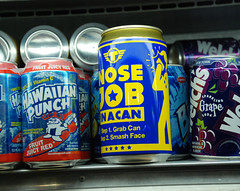
Trusto Corp's Nose Job In A Can and more!


http://consumerist.com/2010/04/buy-yourself-a-nose-job-in-a-can-a-bulimia-bar.html

Want a Nose Job in a Can? Trusto Corp is the art collective behind a number of public consumer interventions.

Check out some of their recent hysterical/profound tactical media exploits around town on their Flickr page.

Saturday, March 13, 2010

How can God protect me from robots?

It looks like a bunch of Gallatin students staged a robot invasion against Bible Crusaders:

http://www.youtube.com/watch?v=e5L6lwkF3AM (embedding disabled by request, but this one documents the actual invasion as opposed to the one below, which is more from an organizational point of view)

Thursday, March 4, 2010

Banana Land Campaign.

The statement below is from an organiziation that is working to put together a grassroots org to make legible the labor behind the production of bananas. Might there be some action we can take on behalf of this group to aid in their cause?

The history of the big banana companies in Colombia is long and bloody. On December 6, 1928 close to 2,000 banana workers and their families were gunned down during a peaceful protest in Cienega Colombia by mercenaries and the Colombian military. The company these families were protesting was their employer, United Fruit Company who later evolved into Chiquita. Colombians then and now hoped for change in the way the banana industry operated in their country. Now, 81 years later, the world's largest producers of bananas, Chiquita and Dole, are in US courts defending themselves against allegations of payments made to AUC (United Self Defense forces of Columbia) paramilitaries as recently as 2007. These paramilitaries maimed, murdered, raped, displaced and assassinated thousands of workers and their families in the interest of global business. The AUC is considered a Terrorist organization by the US state department. We simply feel that this behavior is unacceptable and we will work to hold these companies accountable.


For more info check out their website


For a preview of their documentary click here


Thursday, February 25, 2010

justseeds.org

Here's some info on the Justseeds which was mentioned in today's class.

Who We Are

Justseeds Artists' Cooperative is a decentralized community of artists who have banded together to both sell their work online in a central location and to collaborate with and support each other and social movements. Our website is not just a place to shop, but also a destination to find out about current events in radical art and culture. Our blog covers political printmaking, socially engaged street art, and culture related to social movements. We believe in the power of personal expression in concert with collective action to transform society.

History
Justseeds was originally started in 1998 by artist Josh MacPhee as a way to distribute his art and the Celebrate People's History poster series. He slowly expanded Justseeds to include the work of like-minded artists. In 2006, MacPhee reached out to a dozen like-minded artists and previous collaborators as well as the political street art blog Visual Resistance in order to re-envision Justseeds as a cooperative effort. Justseeds was transformed into Justseeds Artists' Cooperative, an artist/worker owned and run cooperative and blog, that launched in the summer of 2007.

jshq.jpg

Justseeds' shipping department in Portland Oregon.

Monday, February 15, 2010

Contemplating the Void: Interventions in the Guggenheim Museum

Two Thursdays ago, we jokingly entertained the idea of setting up a trampoline indoors somewhere. Well, that's exactly what the Guggenheim is doing as part of its exhibit, Contemplating the Void: Interventions in the Guggenheim Museum. In celebration of its 50th anniversary, the Guggenheim has been accepting proposals from artists as to how to fill the void in the rotunda of the museum, and this exhibit is the culmination of the most provocative themes that surfaced from the two hundred proposals received. View the online exhibit here for examples of other interventions. While not exactly a case study of tactical media, a lot of these proposals/pieces serve as an inspiration in rethinking and reclaiming space.


Friday, February 12, 2010

Fred Wilson and Institutional Critique


Fred Wilson was born in the Bronx, New York in 1954, and lives and works in New York. He received a BFA from SUNY/Purchase. Commenting on his unorthodox artistic practice, Wilson has said that, although he studied art, he no longer has a strong desire to make things with his hands. “I get everything that satisfies my soul,” he says, “from bringing together objects that are in the world, manipulating them, working with spatial arrangements, and having things presented in the way I want to see them.” Thus, Wilson creates new exhibition contexts for the display of art and artifacts found in museum collections, along with wall labels, sound, lighting, and non-traditional pairings of objects. His installations lead viewers to recognize that changes in context create changes in meaning. While appropriating curatorial methods and strategies, Wilson maintains his subjective view of the museum environment and the works he presents. He questions—and forces the viewer to question—how curators shape interpretations of historical truth, artistic value, and the language of display, and what kinds of biases our cultural institutions express. In his groundbreaking intervention, “Mining the Museum” (1992), Wilson transformed the Baltimore Historical Society’s collection to highlight the history of slavery in America. For the 2003 Venice Biennale, Wilson created a mixed-media installation of many parts, focusing on Africans in Venice and issues and representations of black and white, which included a suite of black glass sculptures; a black-and-white tiled room with wall graffiti culled from texts of African-American slave narratives; and a video installation of Othello screened backwards. Wilson received a John D. and Catherine T. MacArthur Foundation Achievement Award (1999) and the Larry Aldrich Foundation Award (2003). He is the Distinguished Visiting Fellow in Object, Exhibition, and Knowledge at Skidmore College. Fred Wilson represented the United States at the Biennial Cairo (1992) and Venice Biennale.

For more on Fred Wilson and his work, check out this episode of PBS series Art: 21. It's a great series, but if you want to skip ahead, Wilson's segment begins at chapter 6.
Thursday, February 11, 2010

An unconventional performance platform

hey all:

how bout an intervention in a laundromat... there's something perfectly unsuspecting about it.

"The Laundromat Project is a public art non-profit dedicated to making art accessible to its New York City neighbors by commissioning public art projects and hosting art-making workshops in local coin-ops throughout the city"

check out this link for more info:

http://www.laundromatproject.org/home.htm

food for thought,
Tory

Friday, February 5, 2010

Shimon Attie reconceptualizes canvas


Shimon Attie Between Dreams and History

October 22nd - November 14, 1998
intersection of Ludlow and Rivington
Photo © 1998 Shimon Attie

Between Dreams and History explored the relationship between site, memory, and identity. Artist Shimon Attie recorded memories of immigrants on the Lower East Side and projected these writings on the walls of their buildings, using laser lights. This project was made possible in part thanks to the public art organization Creative Time.

Tuesday, February 2, 2010

Mark Maloff gets carried across Manhattan


Regardless of what the mission was, this project is a simple yet solid exploration of cooperation and human contact between strangers in urban areas. Note too that Malkoff depended on Twitter to mobilize strangers to meet him at a street corner and carry him when volunteers were scarce. How much of his success was due to participants wanting attention is up for debate, but the idea of getting strangers to help you, to cooperate in helping you, and to physically respond to your online call for help is very much reflective of our increasingly fragmented, yet at the same time, connected society.

Sunday, January 31, 2010

Some Projects by Jill Magid

Jill Magid (b.1973) is an American artist based in New York and Amsterdam. Through her work she seeks intimate relationships with impersonal systems and technology.

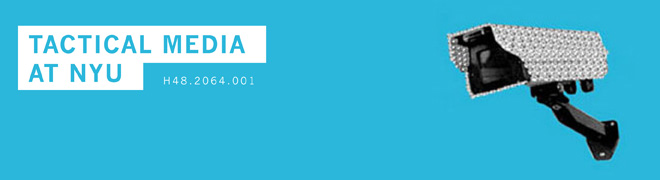
Much of her work involves interventions with institutional and governmental surveillance/ CCTV systems. For her project System Azure she created a fictitious company with which she was able to convince the Dutch government to allow her to decorate the city's surveillance cameras with rhinestones.


An earlier project that surveillance equipment was Lobby 7 performed while she was a graduate student at MIT. The performance involved Magid hacking into the school's CCTV system and hooking the monitors up to a small camera she moved across her skin underneath her clothing.


Years later, while in Liverpool for the Biennial she befriended the technicians at the city's surveillance center. Using the city's surveillance system, the technicians guided her blindfolded through Liverpool in a project which would become Evidence Locker.

Street installations: Cupcakes and Animals

If you're in the mood for some pleasurable tactical media...

Cakespy is basically a group of people headquartered in Seattle who are obsessed with baked goods, and one of the ways they channeled that obsession was through street installations of plaster cupcakes:


"We liked the idea that the novelty of finding such an unusual art object in an unexpected spot might give viewer pause. Perhaps coming across one of these little cupcakes it made them smile, or maybe it annoyed them as a piece of rubbish. Maybe it made them scratch their head and wonder why. But in any instance, the ultimate goal was a repreive--a momentary escape from everyday worries, and a small reminder that yes, life can be strange--but sometimes sweet."

Alexis Lloyd, a new media artist/designer, invaded NYC with her zoo of plastic animals in 2007 as part of her Geek Graffiti class (taught by Evan Roth!):


Lloyd is currently a "Creative Technologist in the Research and Development Lab at The New York Times, where she investigates technology trends and prototypes future interfaces for content delivery." She has a lot of other good projects up on both her professional site and her school site from when she was an MFA student at Parsons. Also check out some of Evan Roth's projects if you're interested in new technologies, open source, and graffiti.

Case Study: Phillipe Petit


The film Man On Wire documents the plans and execution of a project by french tightrope walker Phillipe Petit. The project took over a year's time to execute, and so serves as a case study for the possibility of the long project in tactical media. Take a look at the trailer for the film if you haven't already seen it.


The Yes Men's World Economic Forum action


Last week the Yes Men distributed these to coincide with the World Economic Forum in Davos. The first (fake) press release:

World Economic Forum Press Release

Helmut Limnander, Associate Director, Tel.: +44 (0) 79 4073 9950 – helmut.limnander@we-forum.org, twitter

World Leaders Pledge Strategy To End Poverty Now

  • Selected pre-interview policy statements from notable WEF guests to the 40th anniversary of the Forum's Annual Meeting in Davos, drawing leaders from business, government and civil society
  • Klaus Schwab, Founder and Executive Chairman, announces key goals and strategies
  • Key world leaders adopt cogent and actionable set of initiatives to eliminate poverty in the near term: http://www.we-forum.org/initiatives
  • For complete statements click here: http://www.we-forum.org/annualmeeting

Davos, Switzerland, 27 January 2010 – In preparation for the 40th anniversary annual meeting of the World Economic Forum, several key world leaders have pledged to develop, by the end of this year's meeting, a cogent and actionable plan to end global poverty.

Schwab Speech"In light of the recent tragedy in Haiti, which was already on the brink due to free-market policies, it is clear that taking a new tack to end poverty is morally necessary," saidFounder and Executive Chairman Klaus Schwab. (See video here.).

In a series of pre-recorded policy statements, which can be viewed on the Davos Annual Meeting 2010 website, President Sarkozy of France, Chancellor Merkel of Germany, CEO Patricia Woertz of Archer Daniels Midland, and several other political and business leaders note the failures of a system that has been more intent on using poor countries as supply-houses for raw materials than in bringing them out of poverty.

"Today, we are at a moment of societal crisis when dramatic change is inevitable," saidChancellor Merkel. "The only question is: will we help to usher in that change, or will we be its victims?" (See video here.)

The leaders support a refreshingly simple plan that will end poverty, protect the environment, and allow developing countries to choose their own futures, unchained from onerous debt obligations and unbalanced trade policies.

Merkel WEF Speech

Harper WEF Speech

Woertz WEF Speech

"Our government is committed to helping end old colonial patterns that continue today, and that have only worsened under neoliberalism," said Queen Elizabeth II, during a pre-taped message issued from Parliament that focused on the similarities between European powers' colonial policies and modern trade policies. "Now is the time to rebuild." (See video here.)

"Nobody wants a catastrophe," said Canadian Prime Minister Stephen Harper. "Canadians don't want that reputation." (See video here.)

Above all, the new policy statements are indicative of significant change of direction by some of the most powerful people in the world. The testimonials augur a watershed week during which the leading powers of Davos will be striking at the heart of policies and structures that, while contributing to economic growth for businesses, have created the conditions for poverty and have threatened the very survival of humankind.

The Forum's bold change of direction comes after an exhaustive internal survey by the Forum's Leadership Council, as well as extensive consultation with anti-poverty leaders and campaigners in the developing world. Among the statistics presented:
  • In 1820, the gap between the richest and poorest country was 3 to 1. In 1950, it was 35 to 1. Today, it is nearly 80 to 1 (source).
  • In 1970, 434 million people were suffering from malnutrition. Today, that number is approaching 900 million (source).
  • Since 1960, Third World countries have suffered a 70% drop in the price of agricultural exports compared to manufactured imports (source).
  • The developing world spends $13 on debt repayment for every $1 it receives in grants (source).
  • It is estimated that USD$11.5 trillion of untaxed "black money" is being held in global "tax havens" (source), with as much as USD$1 trillion in unmarked Swiss bank accounts (source). The United Nations has estimated the cost of ending world hunger at about USD$30 billion a year (source).
  • The World Bank reports that spreading global economic crisis is set to trap up to 53 million more people in poverty in developing countries, bringing the total of those living on less than $2 a day to over 1.5 billion (source).
"We have to look at this year's meeting in the context of what's happening in the world," said Professor Schwab. "We just killed the Copenhagen Summit, we crashed many economies in 2009. Clearly the present system of rampant capitalism is not worthy of salvaging. This is the reason why our Annual Meeting this year is tailored around the need to end poverty once and for all." (See video here.)

Professor Schwab noted that the need to end poverty is felt especially strongly this year, with an earthquake-ravaged Haiti foremost on people's minds. A series of protracted pre-conference discussions were held by Forum members in response to the recent gaffe by the International Monetary Fund, in which the Fund's loan to Haiti, bearing a number of onerous conditions, became the target of popular uproar, forcing the Fund to commit the monies in the form of a grant instead.

In a refreshing taste of things to come, Forum members resolved to supplement the IMF grant with a much larger, multi-billion dollarunconditional grant to Haiti, to be excised from the more than USD$60 billion that New York's financial sector awarded themselves in bonuses this year.

"It is by now universally understood that many of our institutions were directly responsible for the collapse of housing value, not to mention massive unemployment and misery, in the United States and much of the rich world," said Lloyd Blanfein, Chair of the New York Financial Caucus, and current Chief Executive Officer of Goldman Sachs.

"But it is equally true that we in the financial sector bear much responsibility for Haiti's poverty, which has made it impossible for them to even begin to deal with the current tragedy," added Blanfein. "The least we can do to repay our moral debt is to immediately lift up the collapsed Haitian economy, and not by making usurious loans through the IMF, either."

Notes to Editors


The World Economic Forum is an independent international organization committed to improving the state of the world by engaging leaders in partnerships to shape global, regional and industry agendas.

Incorporated as a foundation in 1971, and based in Geneva, Switzerland, the World Economic Forum is impartial and not-for-profit; it is tied to no political, partisan or national interests. (http://www.we-forum.org)

World Economic Forum, 91-93 route de la Capite, 1223 Cologny, Switzerland

The follow-up:

FOR IMMEDIATE RELEASE
January 28, 2010

Scurrilous Videos Besmirch, Enrage Forum, Leaders, World
Videos threaten very existence of WEF

In a series of diabolically stupid video manipulations, a cabal of anti-poverty filmmakers have performed an elaborate slander of the World Economic Forum, showing its "leading lights" taking a dramatic departure from the litany of meaningless pledges they usually make at the annual gathering in the Swiss resort town.

In response, WEF spokesperson Adrian Monck could barely contain himself. "The only defense to satire is common sense!" he sputtered, before racing back into the WEF war room to deal with the burgeoning crisis.

Fortunately for the WEF, few media outlets picked up on the WEF's fantastic but fictional approach to world poverty ("World Leaders Pledge Strategy to End Poverty Now"). Instead, the media was dominated by coverage of a real WEF press release warning of "Over Regulation of the Financial Sector" (sic).

The forged videos showed eight of "leading lights of Davos" outlining a few clear strategies to end poverty.

The CEO of Archer Daniels Midland, the world's largest agribusiness conglomerate, spoke of "agriculture's role in today's economic savagery, and the broader long-term issues of robbing whole groups for the greed of the food industry," before calling for "universal justice and agriculture's reform" via Food Sovereignty. "We want to undo the injuries of global capitalism," added a much-improved "Klaus Schwab," founder and executive chairman of the World Economic Forum.

"The source of our financial treasure was violence towards the colonies of the global South," admitted "Queen Elizabeth II" most refreshingly, before pledging to sell her lands and use the proceeds to improve the lot of the world's poor. "We have caused this disaster," added "Prince Harry" with a stalwart giggle. "Nobody wants a catastrophe," Canadian Prime Minister "Stephen Harper" chimed in most helpfully.

"Haiti was a house of cards that we built through a history of exploitative economic policies," said a tired-looking "Bill Clinton." Now we have a chance to rebuild a more independent society by ending exploitation, forgiving their debt and bringing back real sustainability."

The perpetrators included a prominent film director, several Hollywood voice actors, at least one disaffected member of the World Economic Forum itself, and thirty-four of the Yes Men.

"Yes, these are real talking heads," explained Robert Diaz Leroy, a Hollywood film producer who was one of those behind the action. Another co-conspirator, film director Philippe Diaz, went into greater detail.

"We did this out of frustration with the fact that each year in Davos, the wealthy and powerful figure out ways the global economy can continue to benefit them," said Diaz, who directedThe End of Poverty?, which opens this Friday in New York. "Even this year, they're still talking about economic growth and de-regulation as the solution to poverty. That's especially obscene in light of this year's economic crisis, which resulted from those exact policies and has disproportionately affected the poor."

Despite the WEF's annual posturing, neoliberal policies have proven to be a massive failure for the vast majority of the poor, said Diaz. "When a disaster strikes a poor country like Haiti, our culpability becomes graphically clear."

Diaz explained that growth has by and large benefited only the wealthiest fraction of the population. "Our economic system depends on the resources of the global South that we have plundered since 1492. Only the tools have changed: nowadays we rarely use guns or armies, we mainly use economic instruments. But the damage is just as real." (See the fake press release for some real statistics to that effect.)

"What you won't hear in Davos is anything about the structural factors at the root of global poverty," said Beth Portello, who produced The End of Poverty?. "Poverty is created: it's the byproduct of centuries of exploitation of human and natural resources maintained into modern times by unfair trade, tax and land policies, and odious debt."

"Unlike the lip-service solutions from Davos, the proposals on our fake WEF site would actually end poverty," said Diaz. "We're going to do everything we can to make them happen. The film is just the beginning."

"Poverty isn't an accident, and it won't end by accident, either," added Portello.

In a dramatic bit of irony, it was revealed that the fake Queen Elizabeth II was played by boy actor James O'Keefe, who was recently arrested for feloniously attempting to tamper with the phone line of U.S. Senator Mary Landrieu, not long after being honored by House Republicans for his "ACORN pimp" role last year.

"Oh that queen," said Andy Bichlbaum of the Yes Men. "Who knows what trouble she'll get into next."

***

The End of Poverty?, a film with some real solutions to global poverty, is currently playing in US theatres. If you happen to be in New York City this weekend, come meet Philippe and Beth at screenings this Friday (1/29), Saturday or Sunday matinee at Cinema Village in lower Manhattan. Phillipe, Beth and Andy are all available for interviews in NYC or by phone: conta ctpress@cinemalibrestudio.com or 310-780-4008 to arrange.


Friday, January 29, 2010

Some Projects by Nick Knouf

Nick Knouf (b. 1980) is an artist, activist and researcher currently based at Cornell. His work explores the interstitial spaces between information science, critical theory, digital art, and science and technology studies he maintains the site zeitkunst.org.

Fluid Nexus Project Video from Nick Knouf on Vimeo.


One of his better known projects Fluid Nexus (2008-09) is an application for mobile phones that enables activists to send messages and data amongst themselves independent of a centralized cellular network. This allows for communication in instances where the centralized network has been shut down or is under surveillance.


More recently Nick has developed a series of Firefox extensions designed to aggregates information about colleges and universities involved in what he identifies as the military-academic-industrial complex or MAIC. The screen shot above is a still from Firefox running the MAICgregator (2009) extension on the University of California's official website.


A similar script was written to address privacy concerns with worldcat.org, Cornell University's online library catalog provider. When running the Replace Library Form (2009)script adds a detailed warning statement to the library homepage.